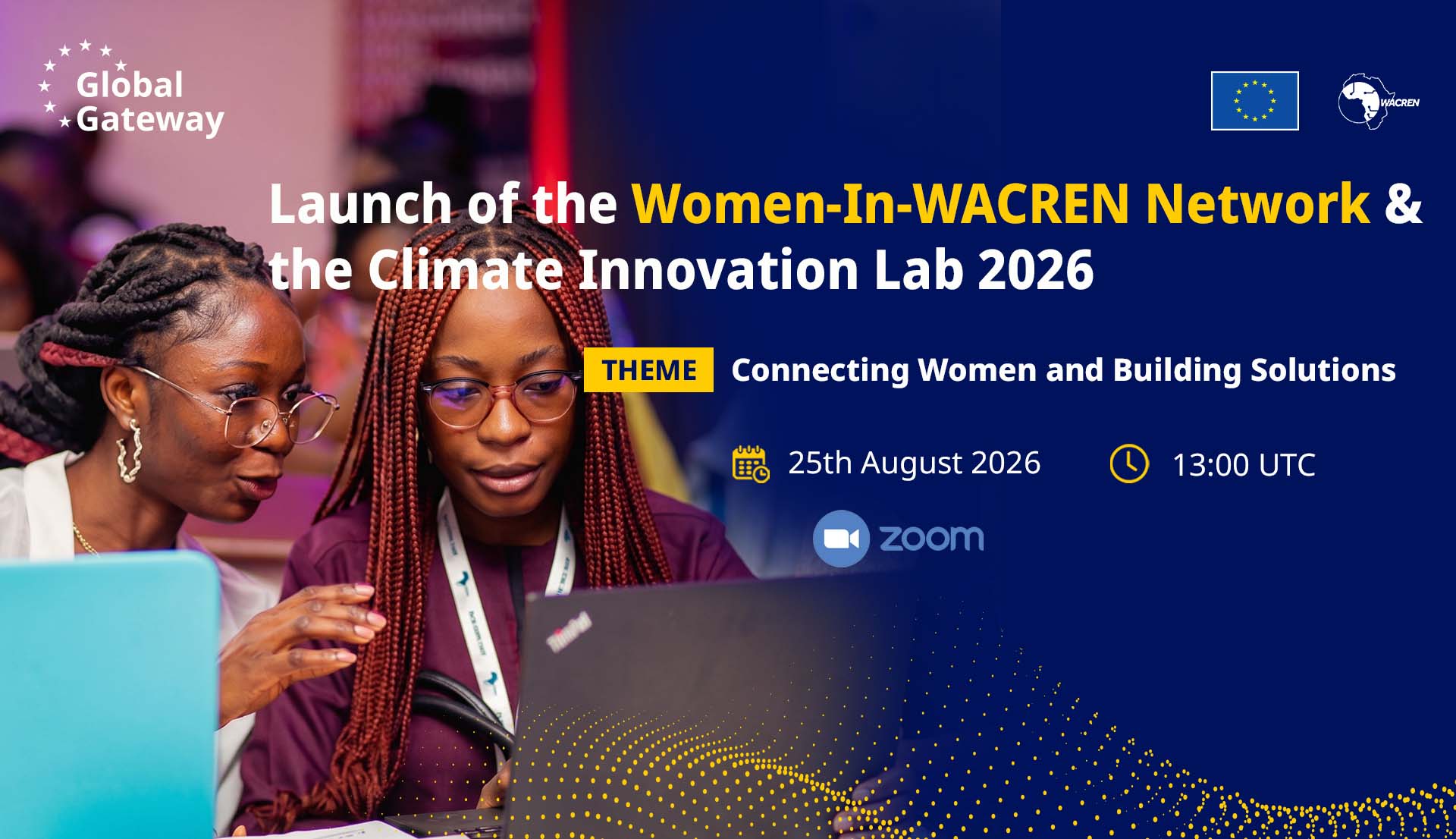

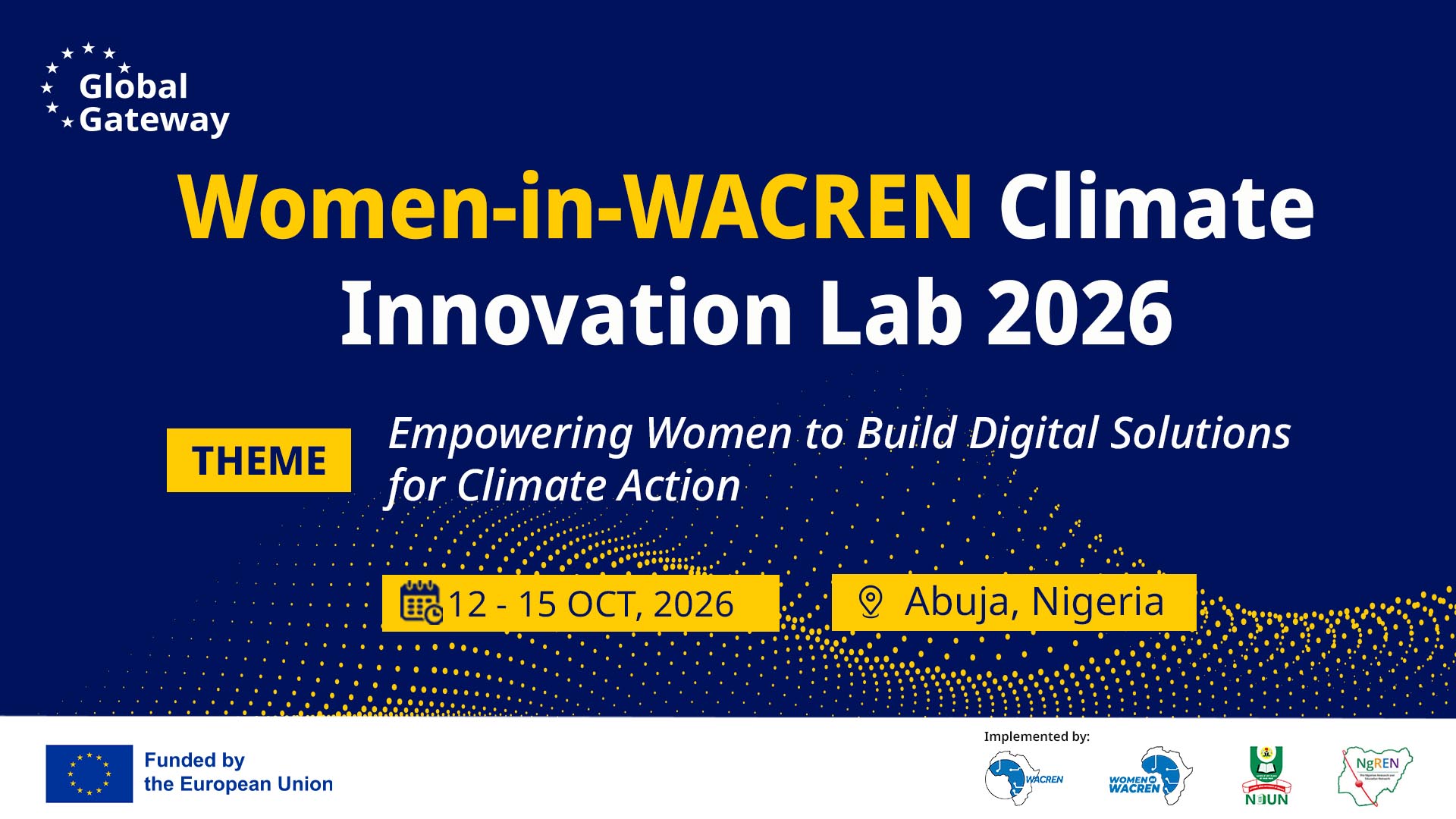
Women-In-WACREN (WiW) is hosting the Climate Innovation Lab 2026, a structured innovation programme that combines a virtual network of women in STEM, an intensive in-person Climate Innovation Lab, and a post-lab mentorship programme. The programme aims to strengthen the capacity of women in STEM across West and Central Africa to collaboratively design and develop innovative digital solutions that address climate change adaptation and mitigation challenges within their communities and institutions.
Programme Coordination & Contact
The Climate Innovation Lab brings together participants, mentors, facilitators, and partners across West and Central Africa to collaboratively design and develop innovative digital solutions.
• Coordinator: W-i-W Coordinator
• Email: wiw@wacren.net
• Phone: +233 501100457
Monday 12 October – Day 1: Understand the Problem
• 08:30 → 09:00 (30m): Registration & Networking – Participants and mentors assemble
• 09:00 → 09:30 (30m): Welcome & Innovation Lab Briefing – Welcome from our Host (NOUN), Welcome from Sponsors (NgREN), Grouping & Expectations (Speaker: Abigail Essel)
• 09:30 → 10:15 (45m): Climate Challenges & People – Introduce the climate-resilience challenges and the people/institutions affected (Speaker: Prof. Amos Kabo-Bah, AfriGEO)
• 10:15 → 10:45 (30m): From Problems to Solutions – Short practical introduction to human-centred design, users, value propositions and assumptions (Speaker: Dr Vivian Chinwe Nnamdi)
• 10:45 → 11:15 (30m): Tea Break
• 11:15 → 12:45 (1h 30m): Team Lab 1: Understand the Problem – Teams examine their assigned challenge, identify target users, needs/pain points, existing approaches and underlying assumptions
• 12:45 → 13:30 (45m): Problem Review with Mentors – Each team presents its problem statement and receives challenge/feedback before designing the solution
• 13:30 → 14:30 (1h): Lunch
• 14:30 → 15:00 (30m): From Ideas to Testable Prototypes – What constitutes a prototype; choosing what needs to be demonstrated rather than building everything (Speaker: Mr Joshua Opoku Agyemang, IoT Network Hub Africa)
• 15:00 → 16:30 (1h 30m): Team Lab 2: Define the Solution – Define intervention, value proposition, key user journey, critical assumptions and prototype scope
• 16:30 → 17:00 (30m): Day 1 Checkpoint – Output: validated/refined problem statement + target users + proposed intervention + critical assumptions + prototype scope (Speaker: Abigail Essel)
Tuesday 13 October – Day 2: Build the Prototype
• 09:00 → 09:45 (45m): Team Build Plans – Teams present what they intend to demonstrate by the end of the day
• 09:45 → 10:15 (30m): Technology Clinic – Just-in-time introduction to relevant tools, data, AI, APIs, low/no-code, web/mobile etc. based on actual team needs (Speaker: Yazid Mikail)
• 10:15 → 10:45 (30m): Build Sprint 1 – Develop core user journey/proof of concept
• 10:45 → 11:15 (30m): Tea Break
• 11:15 → 13:30 (2h 15m): Build Sprint 2 – Build the critical functionality or simulation needed to test the idea
• 13:30 → 14:30 (1h): Lunch
• 14:30 → 16:00 (1h 30m): Build Sprint 3 – Integrate data/content, complete prototype flow and prepare demonstration
• 16:00 → 16:30 (30m): Mentor Prototype Review – Mentors test whether the prototype actually demonstrates the team's central proposition
• 16:30 → 17:00 (30m): Day 2 Checkpoint – Output: testable prototype + defined assumptions/questions for user testing (Speaker: Abigail Essel)
Wednesday 14 October – Day 3: Test, Learn & Refine
• 09:00 → 09:30 (30m): Building Strong Prototypes – What constitutes useful evidence; testing assumptions rather than asking whether people "like" the prototype (Speaker: Ms Chineme Esor)
• 09:30 → 10:45 (1h 15m): User Testing Round 1 – Intended users/domain representatives interact with prototypes; teams observe and collect structured feedback (Speaker: Ms Zainab Usman)
• 10:45 → 11:15 (30m): Tea Break
• 11:15 → 12:00 (45m): Team Lab: What Did We Learn? – Analyse feedback: confirmed assumptions, rejected assumptions, unexpected findings
• 12:00 → 13:00 (1h): Refinement Sprint 1 – Prioritise and implement the most important changes
• 13:00 → 14:00 (1h): Lunch
• 14:00 → 15:15 (1h 15m): Refinement Sprint 2 – Improve prototype and test critical changes
• 15:15 → 15:45 (30m): Demo & Evidence Preparation – Teams prepare problem → evidence → solution → prototype → learning → next-step story
• 15:45 → 16:30 (45m): From Prototype to Pilot – Teams share their 6months detailed step by step plan (Introduce the transition from four-day prototype to six-month development/pilot)
• 16:30 → 17:00 (30m): Day 3 Readiness Review – Output: refined prototype + user evidence + lessons + initial six-month development hypothesis (Speaker: Amina Ramallan, WACREN)
Thursday 15 October – Day 4: Women in WACREN Community Day
• 09:30 → 10:00 (30m): Registration & Networking – Community members, partners and guests arrive
• 10:00 → 10:20 (20m): Women in WACREN Community Day Opening – Welcome address and expectations for the day (Speaker: Abigail Essel)
• 10:20 → 11:20 (1h): Women in STEM: Experiences, Lessons and Key Takeaways – Wider context and inspiration
• 11:20 → 11:40 (20m): 6months Engagement Key Next Steps – Engagement and clarification on 6months programme structure (Speaker: Abigail Essel)
• 11:40 → 12:10 (30m): Tea Break
• 12:10 → 12:40 (30m): Expert & Mentor Reflections – Structured feedback: desirability, feasibility, potential impact and key unanswered questions
• 12:40 → 13:10 (30m): Partner/Community Spotlights – Relevant communities and organisations; focus on resources/opportunities that could help teams
• 13:10 → 14:00 (50m): Panel: Women at the Forefront of Digital Innovation: Harnessing Technology for Climate Resilience in Africa – Conversation with women across diverse countries
• 14:00 → 15:00 (1h): Lunch & Networking
• 15:00 → 16:00 (1h): Community Conversation – Q&A's, connections, country perspectives and opportunities for collaboration
• 16:00 → 17:00 (1h): Commitments & Closing – Teams state what they will take forward; mentor/partner acknowledgements and closing (Speaker: Abigail Essel)